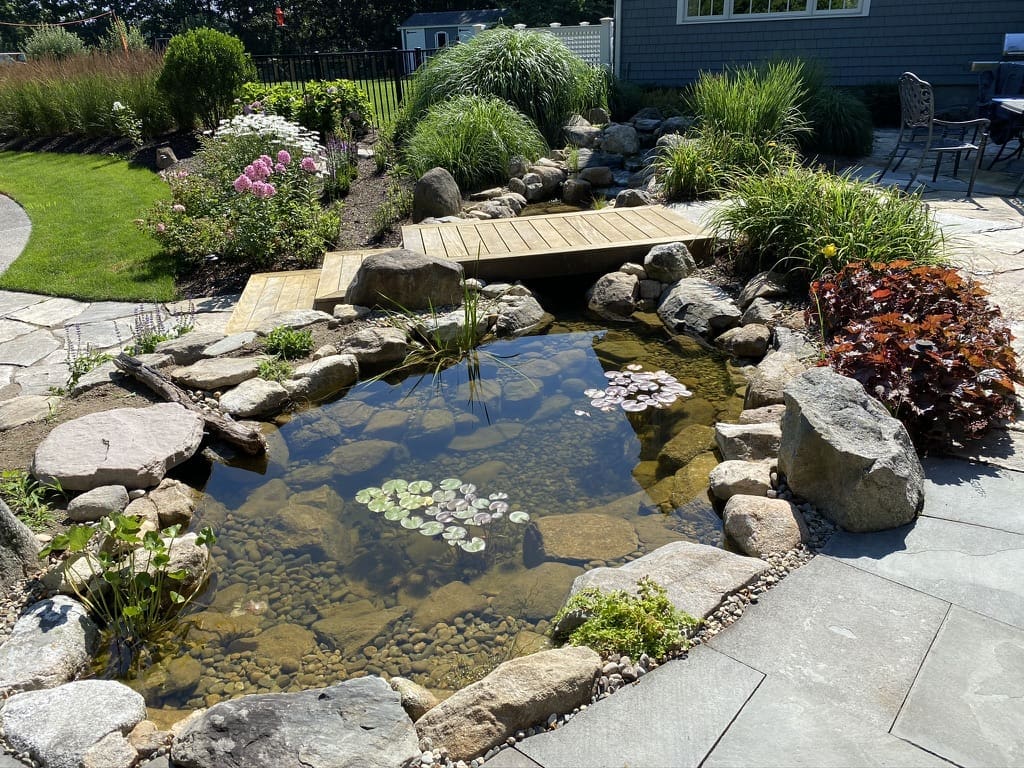
One of the first questions people ask when they start thinking about a backyard pond is some version of the same thing: Don't you have to keep filling it up? It's a fair assumption — but if the pond is built right, the answer is no.
Water evaporates. Waterfalls splash. Summers in Massachusetts get hot. So it seems logical that a pond must need a steady feed from the garden hose to stay full. It doesn't. A properly designed ecosystem pond runs on the same water, day after day, season after season.
Here's how that actually works — and what's going wrong if yours doesn't.
The Recirculating Loop
Tap any component below to see what it does. Water moves through this loop 24 hours a day — the same water, over and over.
The same water, circulating 24/7
Every ecosystem pond runs on a continuous loop: water pulled from the pond, pushed through filtration, returned through a waterfall. Select any component to see its role.
Why Recirculation Matters
When a pond recirculates the way it should, a few things happen.
Water quality stays stable, because oxygen and biology do the work that chemicals and tap water can't. Beneficial bacteria colonize the filter media and rockwork, breaking down fish waste and organic debris before it becomes a problem. Aquatic plants pull excess nutrients out of the water. The waterfall aerates everything.
The pond operates efficiently. You're not pouring town water into the ground, and you're not constantly diluting the biology that's actually keeping the pond clean.
When Does a Pond Actually Need Water?
Even the best-designed pond will lose some water. Evaporation on a hot July afternoon. Wind blowing mist off the top of the falls. A stretch of dry weeks in August. That's normal.
When the water level drops an inch or two, you top it off. Depending on the size of the pond and the weather, that might be every week or two in summer, and much less often in spring and fall. That's a long way from a hose running all the time.
Is Your Pond Recirculating the Way It Should?
Five quick questions. We'll tell you whether your pond sounds healthy, worth a closer look, or ready for a service call.
The Warning Sign
Here's what it comes down to: if your pond can't hold its water without a hose constantly running into it, the system isn't working the way it should. Something is off — a liner issue, a problem with the edge treatment, a waterfall splashing outside the basin, or water escaping somewhere it shouldn't.
The answer in that case isn't more water. The answer is finding the actual problem and fixing it. A pond that's losing a hundred gallons a day isn't an ecosystem — it's a slow-motion plumbing failure, and the water bill will prove it.
Built right the first time, or fighting it forever.
After nearly twenty years of building and maintaining ponds across Massachusetts, Rhode Island, Connecticut, and New Hampshire, I can tell you this: the ponds that stay beautiful year after year are the ones built to recirculate from day one. The homeowners who end up frustrated are usually the ones whose ponds weren't built that way.
If you've inherited a pond that needs constant refilling, or you're planning a new build and want to make sure it's done right the first time — that's what we're here for.
Ready to Talk About Your Pond?
Whether you're planning a new build or troubleshooting a system that isn't behaving the way it should, we're here to help.