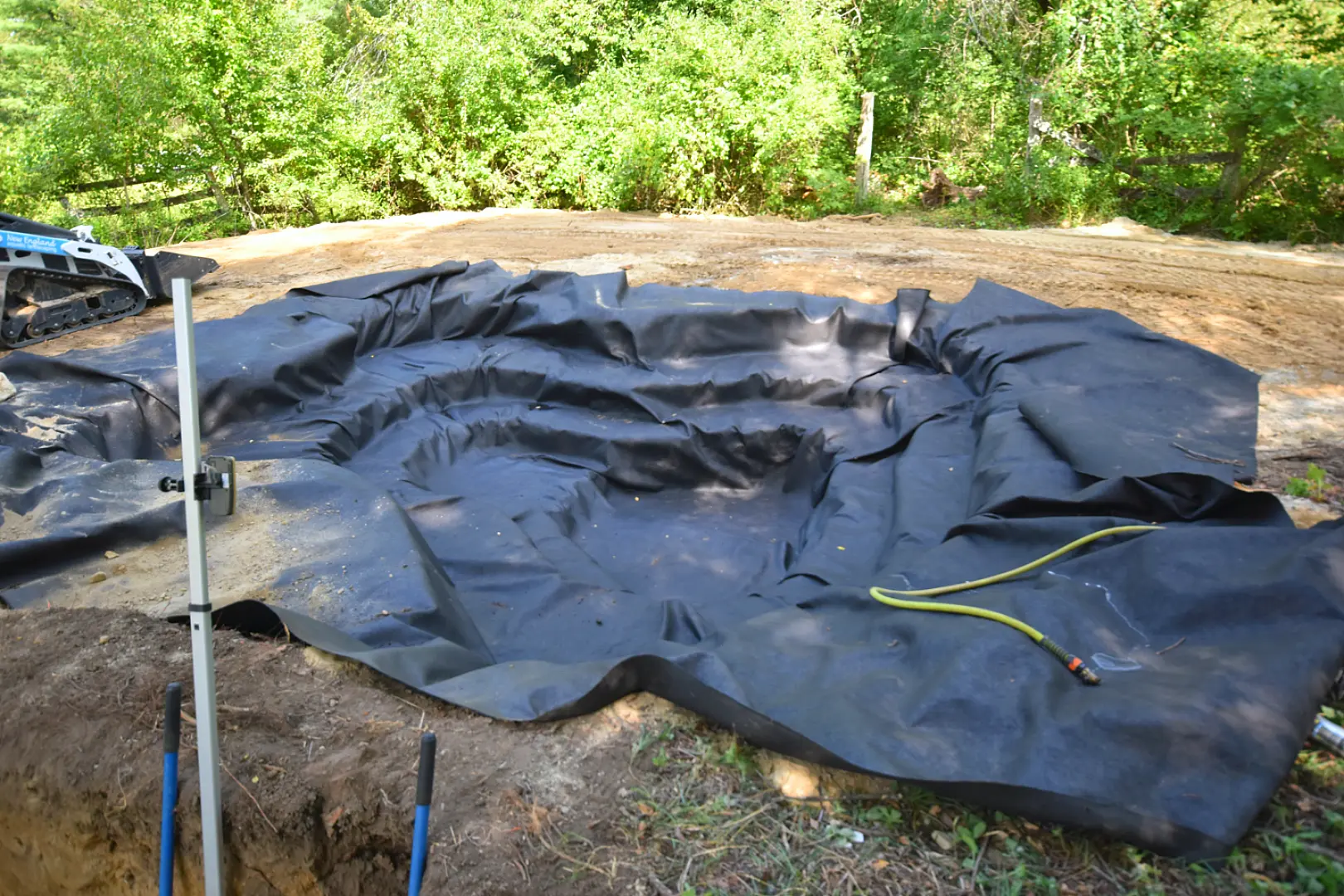
Some homeowners come to us convinced their pond has to have a clay bottom. Someone told them clay is natural, liners are fake, and a "real" pond is sealed with clay. It is a fair question, and the honest answer is that clay and liners are built for two different kinds of ponds. Which one fits depends on what you want the pond to do and what is in the ground under your yard.
This guide walks through how a clay pond works, where it makes sense, why the backyard ponds we build use a liner, and what to do if your yard has a high water table.
How a clay bottom pond holds water
A clay pond holds water because fine clay particles pack tightly enough to slow seepage to a trickle. It is not as simple as digging a hole in clay. To build a sealed clay bottom, the clay is spread in thin layers at the right moisture and compacted with heavy equipment, layer after layer.
The USDA's Natural Resources Conservation Service, which writes the standards most farm ponds are built to, calls for soil with roughly 15 to 30 percent clay and a compacted liner at least 12 inches thick, with more thickness as the water gets deeper. If the soil on site does not have enough clay, it has to be trucked in or amended with bentonite, a clay mineral that swells when wet.
Where a clay pond makes sense
Clay is the traditional choice for large earthen ponds: farm ponds, wildlife ponds, fire and irrigation ponds, and big naturalized ponds on acreage. Those ponds share a few traits:
- They are large and shaped by machine, with gentle slopes and few hard features.
- The site already has heavy, clay-rich soil, or groundwater close to the surface that helps keep them full.
- The owner accepts some seepage, a muddy bottom, and water that is not crystal clear.
- Aeration, not a skimmer and waterfall filter, does most of the work of keeping them healthy. See our pond aeration service for how we handle larger ponds.
If that describes your property and your goals, clay may be the right answer, and we will tell you so.
Why clay struggles in a backyard pond
Most New England yards sit on glacial till: a mix of sand, gravel, stone and ledge. That soil drains well, which is great for your lawn and bad for holding water. Beyond the soil, a backyard pond asks things of its bottom that clay cannot deliver.
- Waterfalls and streams. A waterfall sits above the pond. Clay cannot hold water above grade, so every stream and spillway still needs a liner.
- Rock, gravel and plant shelves. Ecosystem ponds use boulders, gravel and planting shelves to create the surface area beneficial bacteria live on. Setting stone on a compacted clay seal can break it.
- Clear water. Koi and goldfish root around the bottom. In a clay pond they keep stirring fine sediment back into the water. On a gravel-covered liner they don't.
- Drought. When the water level drops in a dry summer, exposed clay shrinks and cracks. Refilling does not always reseal it.
- Burrowing animals and roots. Muskrats, crayfish and tree roots can open seepage paths through a clay bottom.
- Finding leaks. On a liner, a leak is a spot we can locate and patch. In clay, seepage can come from anywhere across the bottom. Our guide on evaporation vs a leak covers how to tell the difference.
Why we build backyard ponds on a liner
The ponds we build use fish-safe EPDM rubber laid over a protective underlayment, then covered with rock and gravel so the liner disappears. A liner holds water regardless of the soil, keeps the exact shape we dig (shelves, a deep zone for fish, the skimmer and the waterfall filter), and lets us build waterfalls and streams anywhere in the yard. When the rock and gravel go in, the pond looks and works like a natural one, which is the whole idea behind an ecosystem pond.
Not every liner is equal. We cover the options in pond liner types compared and why we avoid seamed bargain liners in why cheap liners fail.
Clay vs liner at a glance
| Compacted clay bottom | EPDM liner with underlayment | |
|---|---|---|
| Best fit | Large earthen farm or wildlife ponds | Backyard ecosystem ponds, koi ponds, waterfalls, streams |
| Soil needed | Clay-rich soil on site, or clay brought in | Any soil, including sand, gravel and ledge |
| Waterfalls and streams | Not possible above grade | Built in |
| Rock and gravel bottom | Risks breaking the seal | Standard |
| Water clarity | Prone to muddy water when fish or wildlife stir the bottom | Clear with proper filtration and plants |
| Drought | Exposed clay can crack and leak | Unaffected |
| Leak repair | Hard to locate | Located and patched |
What if you have a high water table?
A high water table means groundwater sits close to the surface, at least part of the year. You may already know it: a wet basement, a sump pump that runs every spring, or standing water in the yard after rain. It does not rule out a pond. It changes how the pond is built.
The problem is groundwater pushing up. Normally the weight of pond water holds the liner down. When the groundwater outside the pond rises higher than the water inside, it pushes up under the liner and lifts it into bubbles, sometimes called whales. It shows up most during spring thaw, after heavy rain, and when a pond is drained for a cleanout. If your pond isn't losing water but the liner is lifting, groundwater is usually the cause rather than a leak.
How a high water table is handled:
- Find it before digging. A site visit in a wet season, or a test hole, shows how high the water comes up. Telling signs: mottled gray soil, water seeping into the hole, or wet spots in spring.
- Give groundwater a way out. Drainage under the liner, such as perforated pipe in gravel running to a sump or to daylight downhill, relieves the pressure before it lifts the liner. NRCS standards call for drainage under a liner whenever the pond bottom is within 2 feet of the seasonal high water table.
- Set the pond elevation with the groundwater in mind. A shallower basin, or a pond set partly above grade, keeps the water inside higher than the water outside.
- Keep it full. A full pond resists uplift. We plan cleanouts for times when groundwater is lower, and we watch the liner when we drain a pond on a wet site.
Sometimes a high water table is an opportunity. On a large property with heavy soil and groundwater near the surface, an unlined or clay pond fed by that groundwater may be the better project. Wet sites can also sit near protected wetlands, so check with your town before planning any digging.
The bottom line
Clay is a good tool for the right pond: large, earthen, on clay soil. For a backyard pond with a waterfall, clear water, fish and plants, a liner is how that pond gets built, on almost any soil and even with a high water table. The right answer starts with a walk around your yard. Book a Discovery Meeting and we will look at your soil, your water table and your goals, and tell you which approach fits.
Frequently Asked Questions
Is a clay bottom pond better than a pond with a liner?
Neither is better in every case. Clay suits large earthen ponds on clay-rich soil. A liner suits backyard ponds with waterfalls, rock, fish and plants, and works on any soil.
How much clay does soil need to hold a pond?
USDA NRCS standards call for soil with roughly 15 to 30 percent clay, compacted in layers to a liner at least 12 inches thick. Most New England yards have far less clay than that.
Can you put a waterfall on a clay pond?
Not out of clay alone. Clay cannot hold water above grade, so waterfalls and streams need a liner even when the main pond is clay.
Can you build a pond with a liner on a high water table?
Yes. The design adds drainage under the liner so groundwater cannot lift it, sets the pond elevation with the groundwater in mind, and keeps the pond full.
Why is my pond liner bubbling up?
If the pond is not losing water, groundwater pressure under the liner is the usual cause, especially after heavy rain, during spring thaw, or when the pond is drained.