Pond Builder and Custom Pond Construction in Massachusetts
We design and build ecosystem ponds that clean themselves: skimmer, biological falls filter, rock, gravel, plants and fish working together. Master Certified Aquascape Contractor with more than 200 water features built across New England since 2008.
Pond builders near you, across New England
We build ponds from Cherry Valley in Worcester County out across MetroWest, Greater Boston and the South Shore. Local pages cover pond construction in Framingham, pond builders in Lexington, pond construction in Norwell and pond builders in Plymouth. New England soil varies from ledge to glacial till to sandy coastal ground, and every Discovery Meeting starts with what is under your lawn.
Builds in Connecticut, Rhode Island and New Hampshire are scheduled in blocks. The crew stages materials, excavation and follow-up visits together, so a project in the Connecticut River valley, on Narragansett Bay or in Seacoast New Hampshire runs as one continuous job. See pond construction in Glastonbury and pond builders in Portsmouth, or check your town on our service area page.
Will a pond really take care of itself?
The honest answer: yes, but only if it's built correctly. A properly designed ecosystem pond is a living system. When the biology, circulation, and filtration are in balance, the pond handles most of the work on its own.
What you won't be doing is constantly fighting chemistry, constantly battling algae, or troubleshooting a system that was never designed to work in the first place. The maintenance burden is a design outcome, not an inevitable feature of pond ownership.
A properly built ecosystem pond typically demands 15 to 30 minutes of maintenance per week during the active season. Compare that to the hours a poorly designed system can consume.
The Biological Cycle
Seven ecosystem pond packages
Every pond we build is custom, and these seven packages are where most projects start. Choose one to see the size, price range, and equipment included.
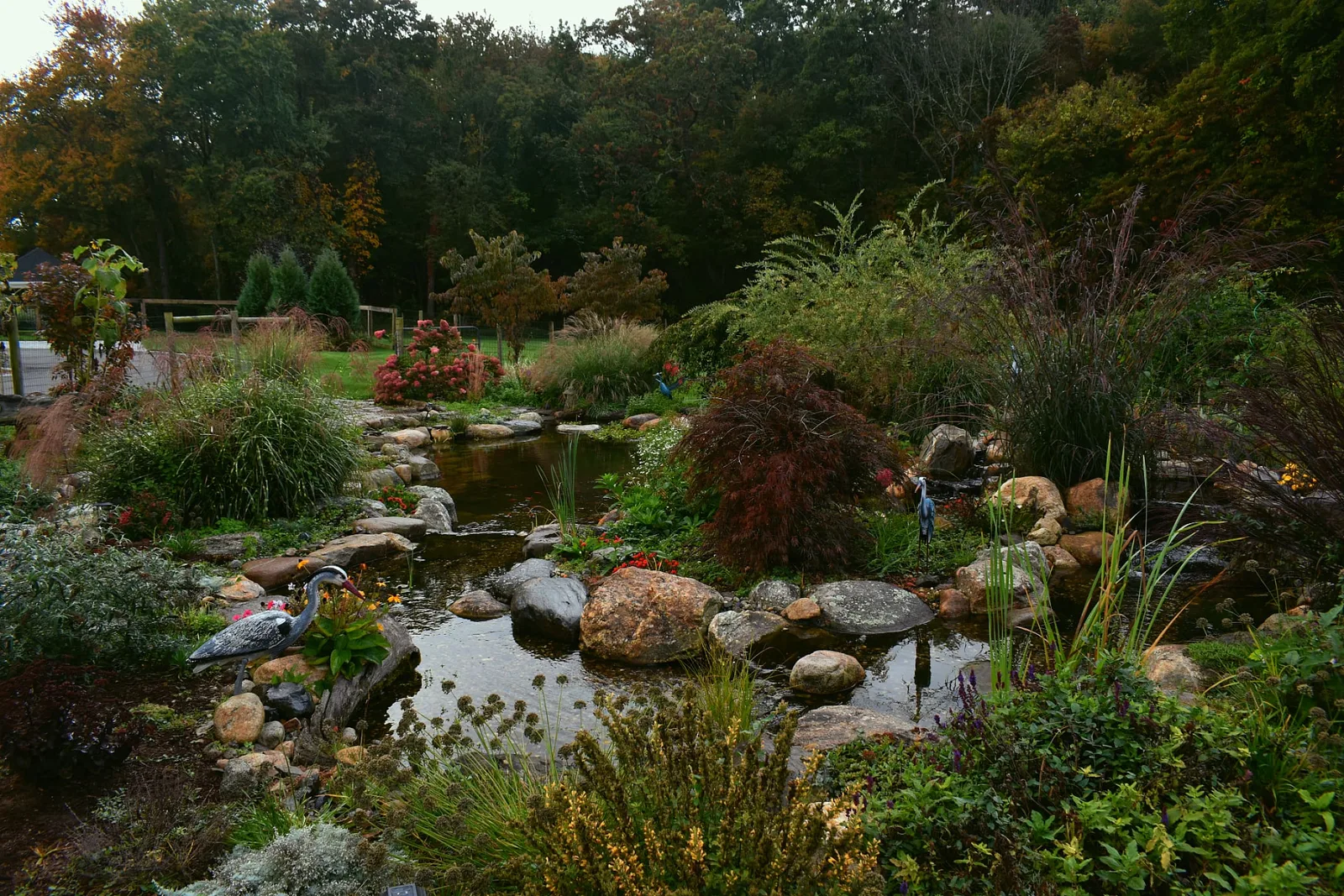
An actual NEAL build at this size.
Package
Backyard Haven
Pond Size
10×15 ft
Depth
2 ft deep
Price Range
$31,000 to $42,000
The package most homeowners choose. Enough water and stone to carry a waterfall and stream, planted edges, and a healthy fish population.
Waterfall and stream, aquatic plants, fish, and a basic lighting package.
What Is Included
- Signature 1000 Skimmer
- SLD 2000-5000 Pump
- BioFalls Filter Signature 2500
- Geo-textile Underlayment and Rock Pad
- 9 tons of boulders
Optional add-ons: Plant Package, Lighting Packages.
Prices are averages and may change depending on the exact size of your pond, your choice of technology and equipment, plants, fish, and overall design. Travel time and distance to and from a project can impact the total project cost. You'll receive an exact quote for your unique pond after the in-home visit.
I'd like to explore my optionsYour pond's first year, what actually happens
The Fill
What You'll See
Crystal clear water.
What's Happening Biologically
No biological cycle yet established. Water is chemically neutral.
What to Do
Run pump 24/7. Add beneficial bacteria starter dose. Add dechlorinator if on municipal water. Do not add fish yet.
Normal or Not?
NormalEverything is as it should be.
What you actually do, month by month
New England ponds have a rhythm. Here's the honest version of what ownership looks like across the year.
Fish feeding: Stop feeding at 50°F
- Manage heavy leaf fall with netting
- Stop feeding when temps drop consistently below 50°F
- Schedule fall cleanout if desired
The questions people are afraid to ask
What an ecosystem pond costs in Massachusetts
Our seven ecosystem pond packages run from $15,000 for the Serenity Oasis up to about $142,000 for the Luxury Retreat. The variables that move the number are real, and worth understanding.
What Your Investment Pays For
Labor
Skilled hand work, stone placed one at a time. The largest cost in a professional build. Shortcuts here show in year three.
Materials
Liner, underlayment, rock, gravel, plumbing, all sized for real conditions, not theoretical minimums.
Equipment
Pump, skimmer, biological filter, quality components sized for your specific system.
Craftsmanship
18 years of knowing how water moves through stone. This doesn't show up on an invoice, but it shows up in year ten.
We've seen professionally built, mature ecosystem ponds specifically noted in property appraisals as contributing meaningful value, in one recent case, on the order of tens of thousands of dollars. A well-built pond gives you a backyard you'll use every day in the meantime, and that has its own kind of value.
A running ecosystem pond costs roughly $25 to $75 per month for a properly sized pump running 24/7 during the active season in Massachusetts, about $38 to $40 per month for a typical medium pond. Water use for topping off evaporation is minimal.
Prices are averages and may change depending on the exact size of your pond, your choice of technology and equipment, plants, fish, and overall design. Travel time and distance to and from a project can impact the total project cost. You'll receive an exact quote for your unique pond after the in-home visit.
Financing available. Build the pond you want now and pay over time. See financing options.
What happens after we leave
- One year parts and labor on everything we supply and install, with longer coverage on pumps, lights and other components
- Seasonal care and membership programs for ponds we build and ponds we didn't
- Once we start, we work every day until your feature is running
Component-specific coverage and exclusions apply. See warranty terms.
Choosing a pond builder in Massachusetts
Any pond contractor can dig a hole and drop in a liner. Ask a few questions before you sign. How deep will it be? Ours are 2 feet standard so fish overwinter under the ice. What filters the water? Look for a skimmer and a biological falls filter, not a pump sitting on the bottom. What liner? We use underlayment and 45 mil EPDM. Does the pond need a hose running into it? A properly built one does not.
Ask to see finished work, ask who does the building, and ask how the quote was reached. Certification matters too. Shawn Cutroni is a Master Certified Aquascape Contractor, and NEAL was named Aquascape's 2026 Regional CAC of the Year.
Our custom pond design process starts with a free phone call, then a Discovery Meeting on your property. Shawn walks the site, looks at grade, sun, trees and views from the house, and designs around them. Packages run $15,000 to $20,000 for a 6x8 Serenity Oasis up to $110,000 to $142,000 for the Luxury Retreat. Financing through Hearth runs 2 to 12 years.
Pond landscaping around the water
Pond landscaping is what makes a pond look like it belongs in your yard instead of sitting on top of it. We set rock and gravel over the liner so none of it shows, build plant shelves into the edges, and carry boulders and plantings past the waterline into the surrounding beds.
Marginal plants soften the edge and take up nutrients that would otherwise feed algae. Lily pads shade the water. Low groundcovers and shrubs around the outside tie the pond to existing gardens, patios and walkways. We place the waterfall so you see and hear it from the house, not just from the back corner of the lot.
Add-ons shape the finished landscape: waterfalls roughly $1,500 to $13,500 depending on the drop, streams roughly $2,650 to $18,000 by length, and lighting packages roughly $3,500 to $7,700. Fall is a strong time to build, since the ground is workable and plantings settle before spring. Read why fall is a good time to build a pond.
Optional Add-On
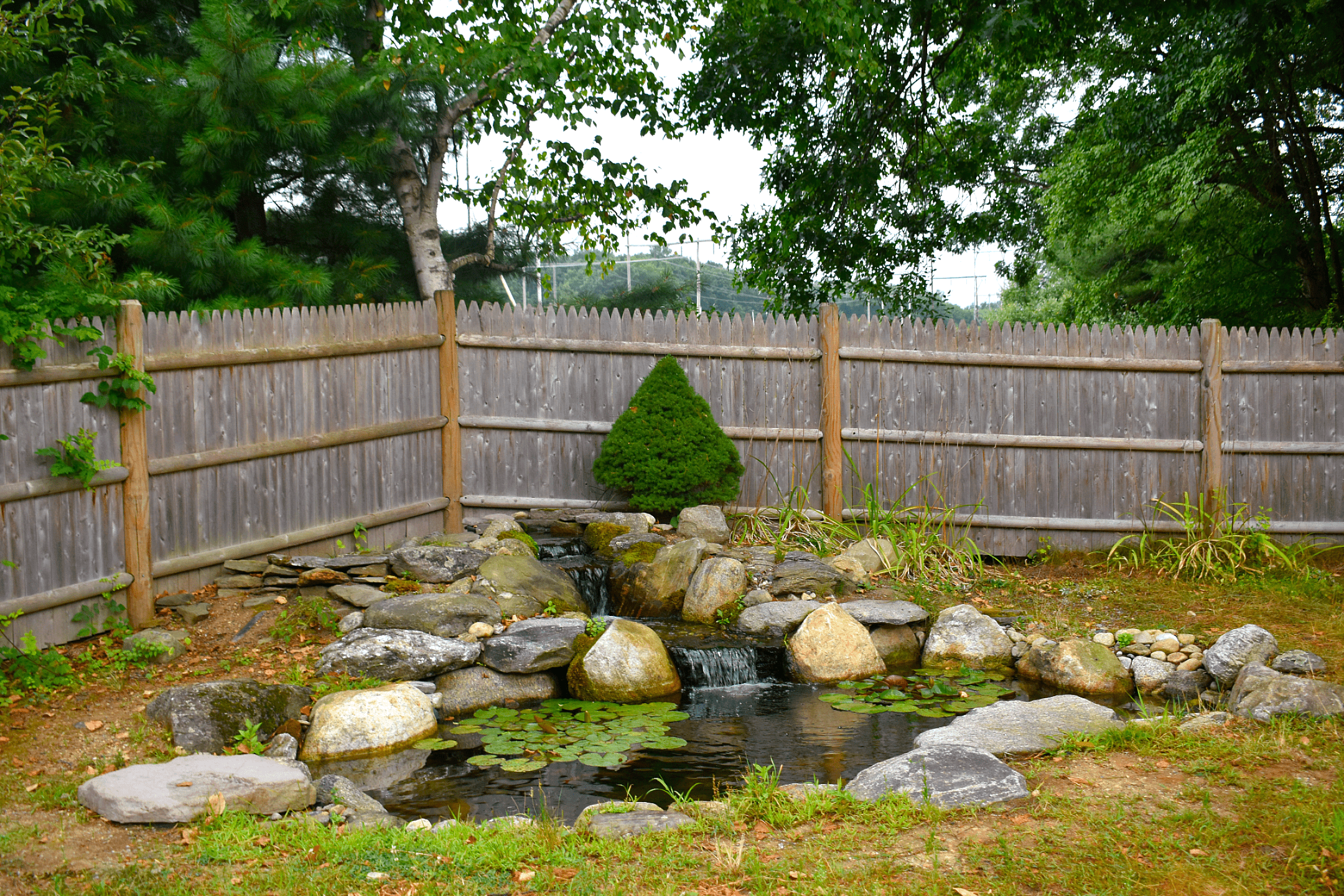
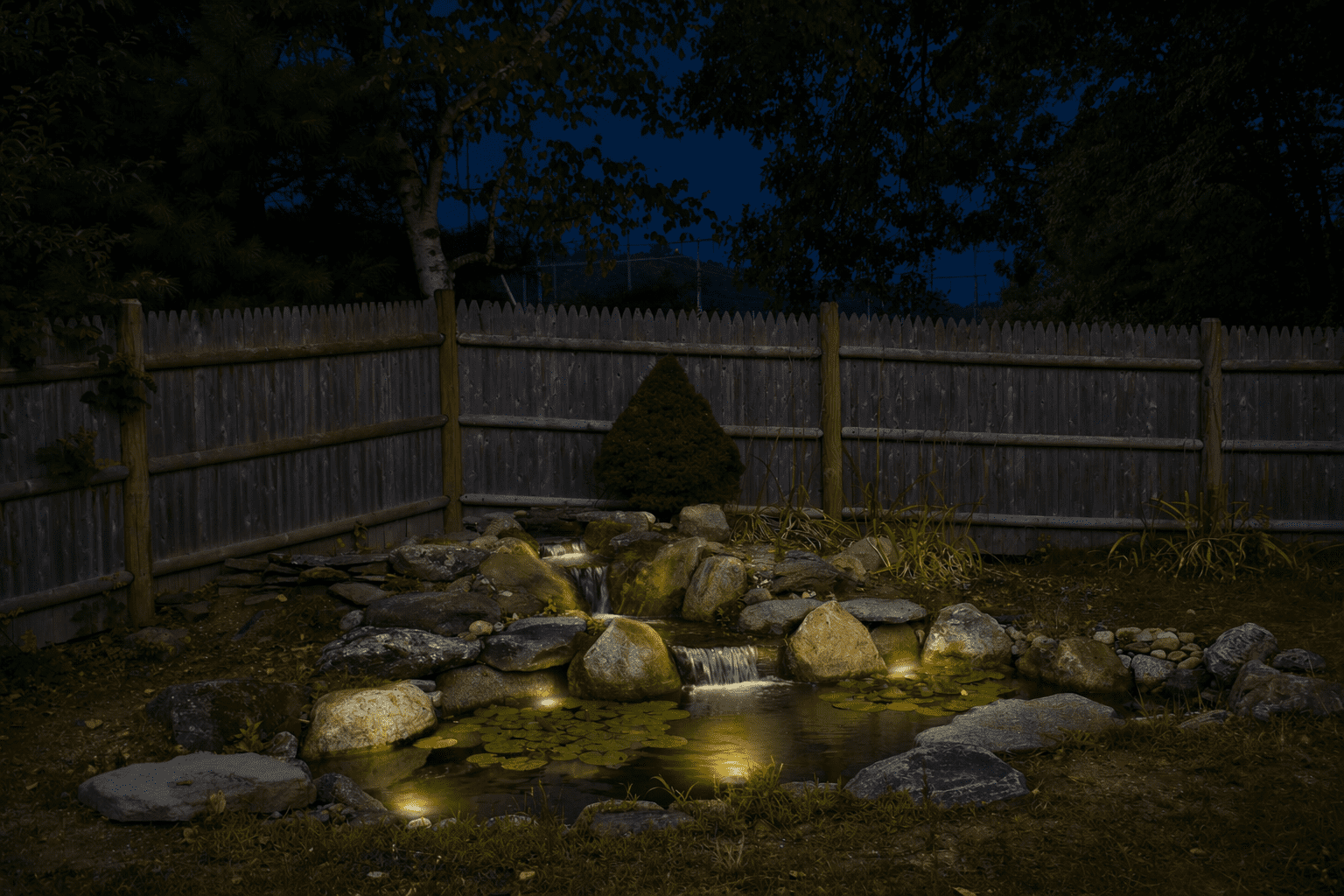
Don't stop at sunset.
Underwater LED lighting is significantly easier to include during initial construction than to retrofit later. See what it does to a feature like yours.
Frequently Asked Questions
An ecosystem pond is designed to function the way nature intended, using the right balance of fish, plants, rock, gravel, beneficial bacteria, and filtration to maintain water quality naturally. Every component plays a biological role. When built correctly, these elements support one another instead of competing. The system largely takes care of itself. That's fundamentally different from what store-bought kits or landscaper-built features typically deliver.
Not at all. Many clients love a pond without fish, and that's a completely valid choice. If fish are something you want, koi are the most popular option and they change how we size filtration and design depth. We'll build it to support whichever direction you go, including the option to add fish later if you change your mind.
Yes, with proper depth (24 to 30 inches minimum) and a de-icer or aerator maintaining gas exchange through the ice. Koi enter a hibernation-like state and survive New England winters reliably in a properly designed pond. Water temperature at 2-foot depth stays above freezing even when the surface is frozen.
Three come up consistently. First: going too small. A slightly larger pond is dramatically more forgiving biologically and more satisfying to live with. Second: choosing a contractor based on price alone. Third: deciding not to add underwater lights during initial construction. After those, overfeeding fish and skipping the spring cleanout are the most consistent ongoing mistakes.
In most cases, yes. Appraisers and buyers tend to treat a mature, professionally built pond as permanent landscape infrastructure rather than a temporary decoration, which is why it shows up as a positive line item rather than a maintenance liability. Just as importantly, it makes a property memorable, and memorable properties hold attention in a competitive market.
Kit systems are assembled to a price point, undersized filtration, minimally sized liners, limited biological design. Professional ecosystem builds are designed to function: the right pump for actual head pressure, filtration sized for the real fish load, liner protected by proper underlayment. The difference becomes visible within 2 to 3 years. Kit systems typically require more intervention and often a rebuild. Well-designed ecosystem builds tend to get easier over time as biology matures.
The most important distinction is whether water features are the contractor's primary craft or an add-on service. Ask to see completed work, not just proposals. Ask how they handle the biological side of the system: if filtration is discussed primarily as equipment specs rather than biological function, that tells you something. Ask what happens after installation. Ask how they approach New England conditions specifically.
Most residential pond installs run 2 to 5 days from first shovel to running feature. Larger builds with multi-tiered waterfalls or custom rock work take longer. We work continuously once we begin, we don't start a project and leave for days at a time.
A spring cleanout is a targeted reset, not an aggressive scrub-down. We drain the pond, transfer fish to a holding tank, pressure-wash rock surfaces and liner, clean (not replace) filter media, inspect all equipment, refill with treated water, return fish, and initiate the spring bacteria program. The key is preserving the beneficial biology you've built, not stripping it in the name of “clean.”
We build from late spring through freeze-up, typically May through November in Massachusetts. Spring cleanout season transitions into summer and fall construction builds. If you're planning for next season, winter is the right time to start the conversation and get on the schedule.
If you are in Massachusetts, Rhode Island, Connecticut or southern New Hampshire, yes. We build across 137 towns from our base in Worcester County. Out-of-state projects are scheduled in blocks so excavation, rockwork and follow-up visits happen together. Every project begins with a free phone consultation at (774) 437-1160, then a Discovery Meeting on your property.
Our seven ecosystem pond packages run $15,000 to $20,000 for a 6x8 Serenity Oasis, $25,000 to $29,000 for the 8x10 Garden Jewel, $31,000 to $42,000 for the 10x15 Backyard Haven, the Fire & Water Escape (12x12, 2 feet deep) starting at $56,500, the Estate Essentials 15x20 starting at $60,000, the Estate Essentials 20x25 starting at $84,000, and $110,000 to $142,000 for the 20x15 Luxury Retreat. Electricity during the season runs roughly $25 to $75 per month. Financing is available through Hearth.
Construction time depends on size, access and soil. Ledge and heavy glacial till slow excavation, and larger packages with streams take longer than a small pond. Shawn gives you a schedule at the Discovery Meeting after seeing the site. Out-of-state builds are booked in blocks so the crew stays on your project until it is finished.
WATCH
Watch how an ecosystem pond comes together.
How we build ecosystem ponds
Ready to start?
Let's design your pond.
Every pond starts with a conversation. Tell us what you're imagining and we'll come take a look at your property, no commitment, no pressure.
Keep reading before you build
Why Fall Is the Best Time to Build a Pond in New England
Fall is the best time to build a pond in New England. Cooler soil, stronger plant roots, no spring waitlist, and a waterfall ready on day one.
Read the guide Pond Building & DesignWhat a Pond Skimmer Does and Why Every Pond Needs One
A pond skimmer catches leaves before they sink, protects your pump, and cuts algae. Learn how skimmers work, where they go, and when to replace one.
Read the guide Pond Building & DesignPond Liner Seams and Cheap Liners: Why Ponds Leak and How Pros Prevent It
Why PVC, big-box, and preformed pond liners crack and leak, what fish-safe EPDM looks like, and how a professional liner seam stays watertight.
Read the guideEcosystem Ponds across New England
We design and build ecosystem ponds with waterfalls, fish, and natural filtration in towns across MA, RI, CT, and NH. Every pond is sized and dug for New England winters, frost depth, and the leaf load of your yard.
Featured Ecosystem Ponds locations
Massachusetts
- Acton, MA
- Andover, MA
- Arlington, MA
- Ashland, MA
- Auburn, MA
- Bedford, MA
- Bellingham, MA
- Belmont, MA
- Beverly, MA
- Bolton, MA
- Boston, MA
- Boxborough, MA
- Boylston, MA
- Braintree, MA
- Brookline, MA
- Burlington, MA
- Cambridge, MA
- Canton, MA
- Carlisle, MA
- Charlton, MA
- Chelmsford, MA
- Clinton, MA
- Cohasset, MA
- Concord, MA
- Dedham, MA
- Douglas, MA
- Dover, MA
- Duxbury, MA
- Fitchburg, MA
- Framingham, MA
- Franklin, MA
- Grafton, MA
- Groton, MA
- Hanover, MA
- Harvard, MA
- Hingham, MA
- Holden, MA
- Holliston, MA
- Hopkinton, MA
- Hudson, MA
- Ipswich, MA
- Kingston, MA
- Leicester, MA
- Leominster, MA
- Lexington, MA
- Lincoln, MA
- Littleton, MA
- Marlborough, MA
- Marshfield, MA
- Maynard, MA
- Medfield, MA
- Medway, MA
- Mendon, MA
- Milford, MA
- Millbury, MA
- Millis, MA
- Milton, MA
- Natick, MA
- Needham, MA
- Newburyport, MA
- Newton, MA
- Norfolk, MA
- North Andover, MA
- North Reading, MA
- Northborough, MA
- Northbridge, MA
- Norwell, MA
- Norwood, MA
- Oxford, MA
- Paxton, MA
- Plymouth, MA
- Princeton, MA
- Quincy, MA
- Reading, MA
- Rutland, MA
- Salem, MA
- Scituate, MA
- Sharon, MA
- Sherborn, MA
- Shrewsbury, MA
- Southborough, MA
- Southbridge, MA
- Spencer, MA
- Sterling, MA
- Stow, MA
- Sturbridge, MA
- Sudbury, MA
- Sutton, MA
- Upton, MA
- Uxbridge, MA
- Walpole, MA
- Waltham, MA
- Wayland, MA
- Webster, MA
- Wellesley, MA
- West Boylston, MA
- Westborough, MA
- Westford, MA
- Weston, MA
- Westwood, MA
- Whitinsville, MA
- Wilmington, MA
- Winchester, MA
- Woburn, MA
- Worcester, MA