Pond & Lake Aeration
Pond and Lake Aeration Systems in Massachusetts and New England
Bottom diffused and surface aeration for farm ponds, retention ponds, lake frontage and backyard ponds. More oxygen at depth means less muck, fewer algae blooms and no winter fish kills. Installed and serviced across New England.
Pond aeration services near you, across New England
We install water aeration systems across Massachusetts from our base in Cherry Valley, Worcester County. That covers Central Massachusetts, MetroWest, the North Shore and the South Shore, where hardwood leaf fall and lawn runoff load ponds with nutrients every year. Farm ponds, retention ponds and lake frontage all qualify. For the ponds that also need regular care, see pond maintenance in Essex County and pond care in Grafton.
Aeration work in Connecticut, Rhode Island and New Hampshire is scheduled in blocks, so assessment, installation and staged startup visits happen on planned trips. That includes Hartford County and the Connecticut River valley, Greater Providence and southern New Hampshire. See pond and lake aeration in Farmington and pond care in Hillsborough County, or check your town on our service area page.
Why aeration matters
Many ponds and lakes suffer from poor oxygen levels caused by stagnant water, decomposing organic matter, and nutrient runoff. That imbalance leads to algae, weeds, muck, foul odors, and stressed fish. Aeration is one of the most powerful, natural ways to restore balance and clarity.
New England ponds face a specific version of this problem. Our water bodies are shallow relative to their surface area, they collect decades of leaf litter from surrounding hardwoods, and they sit downhill from lawns, driveways, and septic fields that send nutrients in with every heavy rain. Then summer arrives and the pond stratifies: a warm oxygen-rich layer floats on top of a cold, dead layer underneath that no longer mixes with it. The bottom third of the pond stops breathing while the organic load down there keeps growing.
That stalled bottom layer is where the visible symptoms come from. Anaerobic decomposition is slow and it releases nutrients back into the water instead of consuming them, which is why the same pond blooms with algae year after year no matter how much you treat the surface. Restore oxygen to the full water column and the pond starts processing its own waste again.
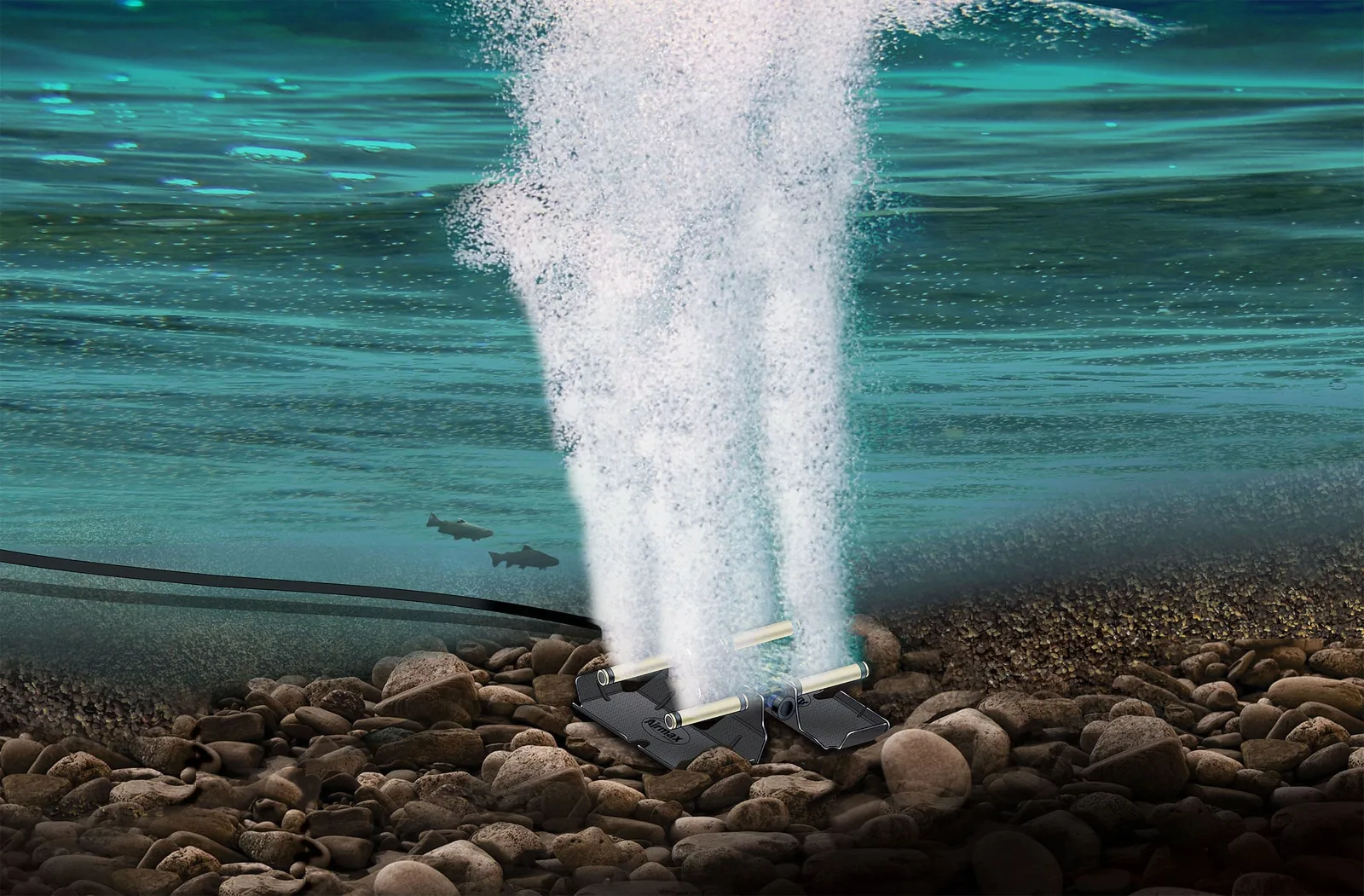
We install and service aeration systems for homeowners, communities, and property managers across Massachusetts, Rhode Island, Connecticut, and southern New Hampshire.
Diagnosis
Signs your pond needs aeration
You rarely need a test kit to know. Ponds short on oxygen tell you in ways that are hard to miss once you know what you are looking at.
A black, soupy layer on the bottom
Muck deeper than a few inches means organic matter is decomposing faster than the pond can process it. Without oxygen at the bottom, that breakdown turns anaerobic and stalls.
A rotten-egg smell near the water
That is hydrogen sulfide venting off an oxygen-starved bottom. It is the single most reliable sign that circulation is not reaching the deepest water.
Fish gulping at the surface at dawn
Dissolved oxygen bottoms out just before sunrise. Fish crowding the surface in early morning are telling you the water column is running short.
Recurring summer algae blooms and mats of weed
Nutrients released from unprocessed bottom muck feed algae, duckweed, and watermeal. Treating the surface without addressing oxygen only buys a few weeks.
Water that clears in spring and fails by July
Warm water holds less oxygen and stratifies into layers that do not mix. A pond that looks fine in May and turns in midsummer is usually a stratification problem.
A winter fish kill
Ice and snow cover cut off gas exchange while decomposition continues underneath. Ponds that lose fish over winter almost always need a maintained opening in the ice.
How aeration works
Aeration is about gas exchange. It releases harmful gases like methane and hydrogen sulfide out of the water column and pulls oxygen in. More oxygen means a healthier, more resilient pond from top to bottom.
Healthier fish and aquatic life
Less muck, sludge, and bottom decay
Fewer foul odors and gases
Cleaner, clearer water
Fewer nuisance weeds and algae blooms
Choose the right system
Surface vs bottom aeration
Both add oxygen, but they do it in different parts of the water column, and the deciding factor is depth. A floating fountain pulls water up from the top few feet and throws it into the air, so gas exchange happens at the surface. A diffused bottom system sits on the pond floor and releases fine bubbles that rise and drag the cold bottom water up with them, mixing the entire column. Under about 4 feet of depth, a fountain moves enough of the pond to matter. Deeper than that, only a bottom system reaches the layer where the muck actually is.
Surface Aeration (Floating Fountains)
- •Visually striking, especially with lighting
- •Controls surface growth like duckweed and watermeal
- •Adds gentle movement and sound
- •Circulates the top 6 to 8 feet only
- •Removed and stored for winter
Bottom Aeration (Diffused Air / Bubblers)
- •Pushes oxygen to the deepest water
- •Ideal for ponds over 4 feet deep
- •Lower-maintenance and year-round operation
- •Preserves the natural look of the pond
- •Best at breaking down muck with full top-to-bottom circulation
In practice, decorative ponds under 4 feet with a swimming or entertaining area nearby usually get a fountain, larger farm ponds and community water bodies with a deep hole get a bottom system, and irregular basins with both a deep section and a broad shallow shelf sometimes get one of each. We make that call during the assessment, after taking depth readings across the pond rather than at one spot.
Our process
Installation and treatment, step by step
There is no excavation and no draining. Most quarter-acre and half-acre systems go in within a single day, and the pond is working on your behalf that evening.
1. On-site assessment
We measure the water body, take depth readings across it, and look at shoreline slope, muck depth, inflow, shade, and fish load. Depth and shape decide the system, not acreage alone.
2. System design and sizing
We map diffuser placement or fountain position, size the compressor or pump to the volume, and plan the power run. Ponds with irregular basins or multiple deep holes often need more than one diffuser station.
3. Shoreline cabinet and power
Bottom systems run from a quiet, weather-rated compressor cabinet on shore. We set the pad, conceal it where we can, and run weighted airline out to the diffusers so nothing floats or shifts.
4. Staged startup
On a pond that has been stratified for years, we do not turn everything on at full output. Mixing the whole column at once can crash oxygen and stress fish. We ramp runtime up over one to two weeks.
5. Optional treatment program
Beneficial bacteria and, where appropriate, permitted aquatic treatments work far better in oxygenated water. Our full-service program schedules those applications through the season so you are not guessing.
6. Seasonal service
Diffuser membranes, compressor filters, and fountain intakes need periodic attention. We handle that on a schedule, along with winter changeover for surface units.
Four real seasons
Aeration through the New England year
A system that is set correctly in June and forgotten in January is only doing half its job. Here is what each season asks of it.
Spring
Ice comes off and the pond turns over. This is when we start systems back up, stage runtime increases, and begin bacterial treatments as water temperatures climb past the mid-50s.
Summer
Peak demand. Warm water holds the least oxygen exactly when fish and bacteria need the most. Most systems run continuously, and this is when the difference between surface and bottom aeration becomes obvious.
Fall
Leaf load arrives. Every leaf that sinks becomes next season muck, so this is the moment to keep circulation strong and bacteria working while the water is still warm enough for them to do it.
Winter
Bottom systems stay on but usually get pulled back to a shallower diffuser or reduced runtime, so the pond keeps an opening for gas exchange without stripping heat from the deepest water. Floating fountains come out and go into storage before ice forms.
Aeration pricing
Systems are sized to the water body. Below are typical ranges to help you plan.
Selected: Quarter-acre system. Prices are averages and may change based on size, site conditions, and design. You will receive an exact quote after the in-home visit.
Pond aeration systems for Massachusetts ponds and lakes
Water aeration systems are sized to the water body, starting with surface acreage and depth. A quarter-acre system runs roughly $4,250 to $6,950. A half-acre system runs roughly $5,450 to $12,250, and a one-acre system roughly $8,970 to $15,250. Smaller backyard pond aeration runs roughly $3,200 to $7,360. Final sizing follows an on-site assessment.
Depth decides the type. A bottom diffused system puts a compressor on shore, runs weighted airline across the bottom, and releases fine bubbles from diffusers on the pond floor. The rising bubbles pull cold bottom water up and break stratification. Surface aeration, a floating fountain, only circulates the top 6 to 8 feet, so it suits ponds under about 4 feet deep. Deeper ponds need a bottom system to reach the muck.
Winter operation matters in New England. Bottom systems keep running but are usually pulled back to a shallower diffuser or reduced runtime, so an opening stays in the ice for gas exchange without chilling the deepest water. That opening is what prevents winter fish kills. Floating fountains come out before ice forms. The compressor uses modest electricity.
Aeration questions we hear most
How do I know whether I need surface or bottom aeration?
Depth decides it. If your pond is less than about 4 feet deep, a floating fountain moves enough of the water column to matter and gives you the visual and the sound. If it is deeper than 4 feet, a fountain only circulates the top 6 to 8 feet and leaves the bottom untouched, so a diffused bottom system is the right call. Ponds with both a deep hole and a shallow shelf sometimes get both.
How long does an aeration system need to run each day?
Most bottom systems run continuously once they are established, because oxygen demand never stops and continuous operation keeps the water column from re-stratifying. During startup on a pond that has been stagnant for years we ramp runtime up gradually over one to two weeks instead of running full output on day one.
What does aeration cost to run?
Aeration is one of the cheaper things on a property to operate. Compressors for quarter-acre to one-acre systems are small draws and run on standard household power from a shoreline cabinet. We size the unit to the water body during the assessment so you are not paying to run more air than the pond can use.
Will aeration by itself clear up my algae?
It removes the engine driving most of the problem, but it is not a chemical fix. Aeration lets beneficial bacteria break down the bottom muck that releases the nutrients algae feed on, so blooms get shorter and less severe over one to two seasons. Ponds with heavy nutrient runoff usually need aeration plus a treatment program to hold clear water.
Can you run aeration through a New England winter?
Yes, and for ponds with fish it is often the most valuable time of year to run it. Ice and snow cover shut down gas exchange while decomposition continues underneath, which is what causes winter fish kills. A properly set winter diffuser keeps an opening in the ice for gases to escape. Floating fountains are a different story: they come out before ice forms and go into storage.
How disruptive is the installation?
Far less than most people expect. There is no excavation of the pond itself. We set a pad for the shoreline cabinet, run power to it, and lay weighted airline out to the diffuser positions. Most quarter-acre and half-acre installations are a one-day job.
Do you install aeration systems near me?
We install and service pond and lake aeration across Massachusetts, Rhode Island, Connecticut and southern New Hampshire, 137 towns from our base in Worcester County. Out-of-state work is scheduled in regional blocks. Call (774) 437-1160 to describe your pond. We will set up an on-site assessment to measure depth and acreage before recommending a system.
How much does a pond aeration system cost?
Systems are sized to the water. A quarter-acre system runs roughly $4,250 to $6,950, a half-acre system roughly $5,450 to $12,250, and a one-acre system roughly $8,970 to $15,250. Smaller backyard pond aeration runs roughly $3,200 to $7,360. Depth, shoreline distance to power and the number of diffusers move the final number.
Should a pond aerator run in winter?
A bottom diffused system usually stays on through winter, pulled back to a shallower diffuser or a reduced runtime. That keeps a hole open in the ice for gas exchange without stripping heat from the deepest water where fish rest. Floating fountains are removed and stored before ice forms. Ponds that lose fish over winter almost always need that opening.
Ready for a healthier pond?
Tell us about your pond or lake and we will schedule an on-site assessment.
I'd like to explore my options