When a pond loses water, most people blame the pump, the weather, or the fish. Very often the real culprit is hiding under the rocks: a liner that was the wrong material from day one, or a seam that was never sealed properly. Here is what actually fails, why, and what a leak-proof liner job looks like.
What a Pond Liner Actually Does
A liner has two jobs. First, it holds water. Whether your yard is loose sandy fill or New England ledge and fieldstone, water will seep out of an unlined hole.
Second, it protects water quality. A good liner keeps out soil, runoff, and lawn chemicals that would otherwise leach into the pond and harm fish and plants. A liner that cracks or tears fails at both jobs at once.
Why Cheap Liners Fail
Most of the leaking ponds we rebuild share the same root problem: the material was never meant to last. Here are the usual suspects.
PVC Liners Turn Brittle
PVC liners are thinner and less flexible than rubber from the start. Over time, especially with sun exposure and our freeze, thaw cycles, they lose their plasticizers, stiffen, and crack. They are also more easily punctured by roots and branches. On older ponds we often find PVC that snaps like a potato chip when you fold it.
Big-Box Material Shreds Apart
On a recent job in Westford, Massachusetts, Shawn ripped out a failing pond built with inexpensive big-box liner material. Over the years it had turned stiff and brittle and was literally shredding, leaving small hidden holes everywhere under the rocks. You cannot patch your way out of that. The whole liner has to come out.
Preformed Plastic Tubs Crack
Those rigid plastic ponds sold at garden centers look easy, but they rarely last. The ground around them shifts and settles, frost heaves push on the shell, and the plastic eventually cracks. We recently rebuilt a small-space backyard pond that started as a cracking, leaking preformed tub (and a home for a remarkable number of spiders). Once it was replaced with a lined ecosystem rebuild, it looked like it had been part of the landscape for twenty years.
Exposed Liner Breaks Down in the Sun
Even good liner suffers when it is left uncovered. UV light degrades exposed material over time, and visible liner simply looks bad. On one property we are transforming, the original pond had shifting gravel, liner showing at the edges, and mulch washing into the water. Those are all signs the liner was never properly covered and locked in with stone.
The Fish-Safe Standard: 45 mil EPDM Rubber
The professional standard for ponds is fish-safe EPDM rubber liner, typically 45 mil thick, installed over a protective underlayment. Here is why that combination works.
- Flexibility: EPDM stays pliable in cold weather, so it conforms to shelves and boulders and moves with the ground through freeze, thaw cycles instead of cracking.
- Durability: It resists UV and holds up for decades when installed correctly and covered with rock and gravel.
- Fish safety: Pond-grade EPDM is made to be safe for fish and plants. Roofing rubber and other look-alike products can contain additives you do not want in your water.
- Underlayment: A geotextile underlayment beneath the liner cushions it from rocks, roots, and sharp ledge.
For a deeper comparison of materials, see our guide to the five types of pond liners.
When Seaming a Liner Is Necessary
In a perfect world, every pond would use one continuous sheet of liner. In the real world, seams happen. The two most common reasons:
- The hole ends up bigger than planned, often because ledge or roots forced the excavation to shift.
- You decide to add a stream or an extra waterfall upstream of an existing pond.
Large features may also need multiple sheets simply because no single roll is big enough. In every case, the seam becomes the most likely failure point in the entire pond.
Why a Single Wrinkle Can Drain Your Pond
Here is the part most people never think about. If two pieces of rubber are joined with even a tiny wrinkle trapped in the seam, that wrinkle forms a channel. It acts like an underground straw, quietly wicking water out of the pond day after day.
The worst part is where it hides. By the time you notice the water dropping, the seam is buried under tons of boulders and gravel. Finding it can mean pulling out the very rock work you paid to have built.
Even after twenty years of building, Shawn calls seaming one of the trickiest skills in the industry. It is not difficult because the steps are complicated. It is difficult because there is zero margin for error.
How a Professional Seam Comes Together
We are not going to turn this into a DIY recipe, because a bad seam costs far more to fix than it does to do right. But it helps to understand what a proper seam involves so you can ask the right questions of any contractor.
- Clean and dry surfaces. Both pieces of liner are cleaned of dirt, dust, and moisture. Any contamination weakens the bond.
- Primer. The rubber surfaces are prepped with a primer that allows a chemical bond rather than a simple stick.
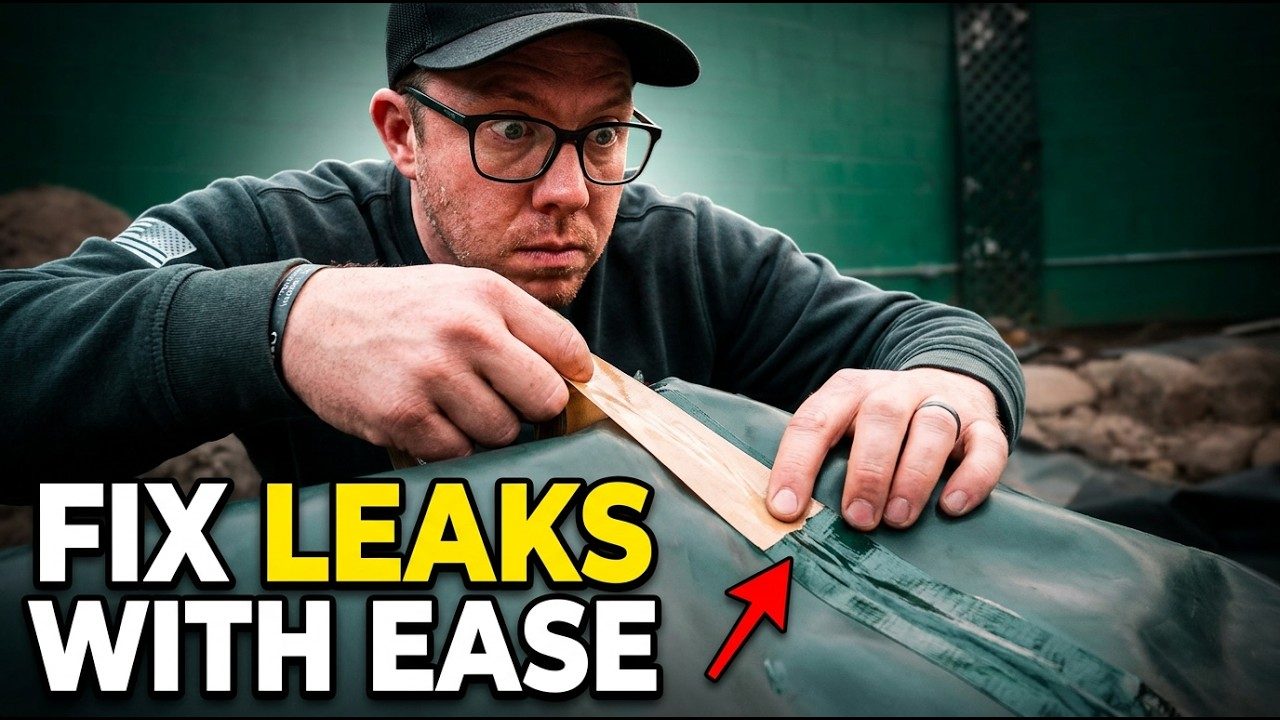
- Seam tape. A double-sided seam tape joins the two layers, applied flat with no wrinkles, bubbles, or fishmouths.
- Rolling. The seam is rolled firmly along its whole length to drive out air and set the bond.
- Cover tape over the edge. A cover strip goes over the exposed seam edge on the water side. This is the step many people skip, and it is the one that seals the edge against water working its way under.
Pro tip: On streams and waterfalls, the upstream sheet should always overlap on top of the downstream sheet, like shingles on a roof. Water then flows over the joint instead of being pushed under it.
Overlaps and Hidden Edges on Waterfalls
Overlap direction matters even where there is no glued seam. On a large pondless waterfall we built, liner placement and overlaps were planned before the first boulder was set, because that is what keeps water inside the system as it tumbles from basin to basin.
Good builders also weave the liner, and sometimes specialized foam, into the rock work so that water cannot run behind stones and escape at the edges. Well-hidden liner edges look natural and are shielded from UV and foot traffic. If you can see liner around your pond, it is worth having someone look at it.
Liner Leak, Evaporation, or Something Else?
Not every drop in water level is a liner problem. Before anyone starts pulling rocks, it helps to narrow down the cause.
- Evaporation: In July, a sunny, breezy pond can lose a surprising amount of water every day. It is steady and tracks the weather. Learn how to tell the difference in evaporation or a leak.
- Liner leak: The water drops to a certain level and then stops. That level often points to where the hole or failed seam is.
- Skimmer or waterfall box leak: We recently rescued a beautiful koi pond that was draining because of a 25-year-old skimmer box that had sprung a leak. The liner was fine. The fitting was not.
- Waterfall or stream edge leak: Low spots along a stream, settled rocks, or debris dams can push water over the liner edge. See understanding waterfall leaks.
A simple test is to turn off the pump and watch the water level for a day or two. If the loss stops, the leak is likely in the stream, waterfall, or plumbing. If it continues, the pond basin itself is the suspect.
Watch: more from the crew on this topic.
Frequently Asked Questions
What is the best liner for a fish pond?
The professional standard is fish-safe 45 mil EPDM rubber liner installed over a geotextile underlayment. EPDM stays flexible in cold weather, resists UV, and lasts for decades when covered with rock and gravel. Avoid PVC, roofing rubber, and thin big-box materials, which can turn brittle, crack, or contain additives harmful to fish.
Why do preformed plastic ponds crack and leak?
Rigid plastic shells cannot flex with the ground. Soil settles, frost heaves push against the sides, and the plastic gets brittle with sun exposure. Eventually the shell cracks, often below the waterline where you cannot see it. A flexible rubber liner moves with the ground and holds up far better in New England winters.
Can you seam two pond liners together?
Yes, when it is done correctly. Seams are common when a pond is enlarged or a stream is added upstream. A proper seam requires clean, dry rubber, primer, seam tape applied without wrinkles, firm rolling, and cover tape over the exposed edge. A single trapped wrinkle can create a slow leak that is hard to find later.
How can I tell if my pond liner is leaking?
Turn off the pump and watch the water level for a day or two. If it keeps dropping and then stops at a certain level, the hole is likely near that line in the basin. If the loss stops with the pump off, look at the stream, waterfall, skimmer, or plumbing instead.
Should exposed pond liner be covered?
Yes. Exposed liner breaks down faster in sunlight, is easier to puncture, and looks unnatural. In a well-built pond, liner edges are tucked behind boulders, buried in soil, or covered with gravel and plants. If gravel is shifting and liner is showing, the pond may need its edges rebuilt.
Talk to New England Aquatic Landscaping
If your pond keeps losing water, your liner is cracking, or you are planning an expansion that will need a seam, our crew can find the problem and fix it the right way. We repair and rebuild ponds across Massachusetts, Rhode Island, Connecticut, and New Hampshire. Contact us online or call (774) 437-1160 to schedule a visit.