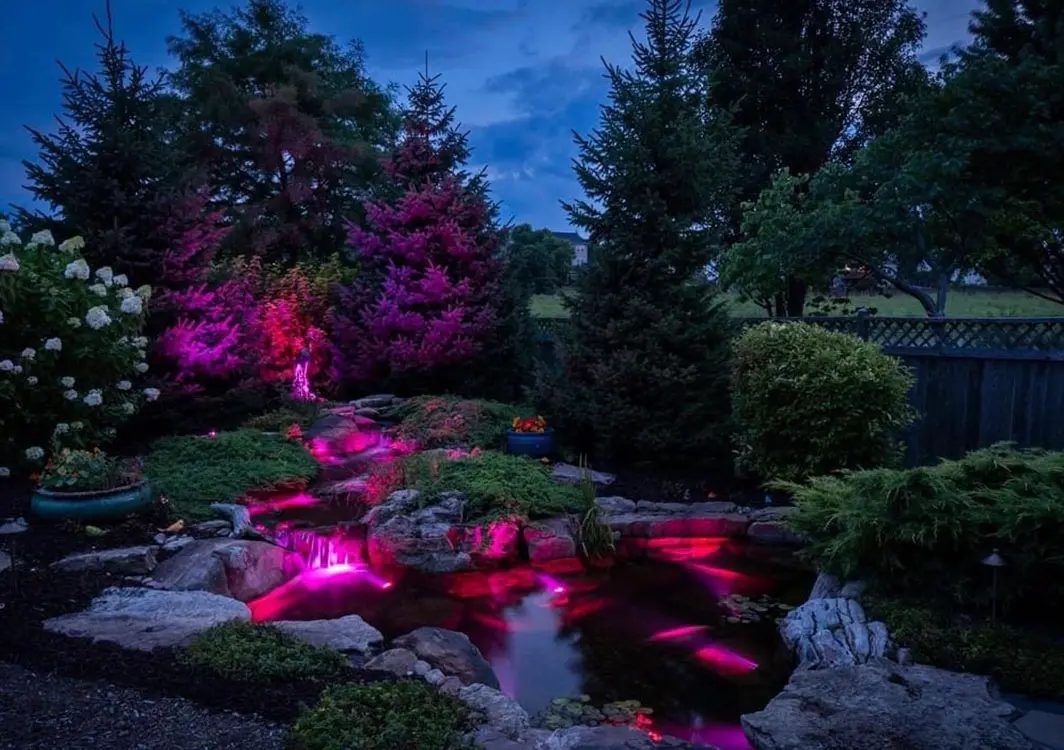
Most ponds disappear at dusk. You spent real money on the boulders, the waterfall, and the fish, and then for half of every summer evening you can hear it but you cannot see it. Good pond lighting fixes that, and it is one of the few upgrades that changes how you use your whole backyard.
Why an Unlit Pond Only Gives You Half Its Value
Think about when you are actually home. On a workday in New England, you leave in the morning and get back in the late afternoon. By the time dinner is done, the light is fading, and from September on it is fully dark before 7 p.m.
That means the hours you have free to sit by the water are mostly the hours it goes black. Sunlight on a waterfall is a great sight, but if you only see it on weekends, you are getting a fraction of what you paid for.
In a recent video on the upgrades that separate an ordinary pond from a true outdoor sanctuary, Shawn Cutroni put architectural lighting at the top of the list. The reasoning is simple: lighting is what turns a daytime landscape feature into a place you live in after work.
What Pond Lighting Actually Does
Lighting a water feature is not about seeing your way across the yard. It does three specific jobs.
It highlights the motion
Moving water catches light in a way still water never will. A submersible light set beneath a waterfall or tucked into a bubbling stream catches the churn and throws moving reflections onto nearby trees, boulders, and the underside of foliage. The whole feature seems to shimmer.
It gives you a new view of your fish
Koi are surprisingly active in the evening during warm months. A few low-voltage lights in the pond let you watch them glide through the water, and their orange, white, and metallic scales pop against the dark in a way you rarely notice at noon. If you have a koi pond, this alone is worth the upgrade.
It extends your living space
A lit pond becomes a focal point for outdoor dinners, small gatherings, and quiet nights by the fire pit. It also makes the area safer. Edges, steps, and stepping stones that are easy to read in daylight become a hazard after dark, and a few well-placed fixtures solve that without flooding the yard.
The Shadow Play Principle
Here is the mistake almost everyone makes on a first attempt: they try to light everything. The result looks like a parking lot or a high school football field. Flat, bright, and lifeless.
The goal is contrast. What makes a lit pond look dramatic is the darkness between the lights, not the lights themselves. Each fixture should reveal one thing, a sheet of falling water, the face of a boulder, a clump of grasses, and leave the space around it in shadow.
Pro tip: Place small, low-voltage lights behind falling water or tucked under the lip of large boulders. You get dancing reflections and deep shadows at the same time, and the fixture itself stays out of sight.
Where the Lights Go
Every pond is different, but the best placements follow a few dependable patterns.
- Under the waterfall. A light at the base of the main drop, aimed up into the falling water, is the single highest-impact fixture on most ponds.
- Behind the falling water. A light set behind a sheet of water backlights it, so the curtain glows instead of reflecting a hot spot back at you.
- Under boulder overhangs. Tucking a light beneath a ledge washes the rock face and hides the fixture completely.
- In the stream. One or two lights along a stream pick up riffles and small drops so the eye follows the water downhill.
- In the deep zone. A soft light in the main basin is where you will see the fish. Keep it low and angled so it does not glare at your seating area.
- Specimen plants and trees. A small uplight on a Japanese maple or a stand of grasses at the pond edge frames the water and gives the scene depth.
Notice what is not on the list: the lawn, the fence, and the path in the middle of the yard. Lighting the water and the stone around it is what you came for. Everything else is supporting cast.
Low-Voltage LED Is the Standard
Modern pond lighting runs on low-voltage LED fixtures fed by a transformer plugged into a GFCI outlet. That setup matters for a few reasons.
- Safety. Low voltage around water and wet hands is the right call. It is the accepted standard for submersible fixtures.
- Energy use. LEDs draw very little power, so running them every evening barely registers. If you want the full picture on operating costs, see our breakdown of how much electricity a pond actually uses.
- Heat and life span. LEDs run cool and last for years, which matters when the fixture is underwater or buried in rock.
- Control. A timer or photocell on the transformer turns the lights on at dusk and off at bedtime, so you never think about it.
Color temperature is worth a moment of thought. A warm white reads as natural and flatters stone and plants. Color-changing fixtures are available, but on most naturalistic ponds a warm, consistent tone looks the most believable.
Common Pond Lighting Mistakes
Most disappointing lighting jobs fail for the same handful of reasons.
- Over-lighting. Too many fixtures, too bright, aimed everywhere. You lose the shadows that make the scene work.
- Visible fixtures. If you can see the light itself from your patio, you see glare instead of water. Fixtures belong behind rocks, under ledges, and below the surface.
- Lighting the lawn instead of the water. Spill light on grass does nothing for you. Aim at the falls, the stone, and the fish.
- Pointing lights at the viewer. A light aimed toward your seating area will blind you. Aim away from where people sit.
- Exposed or tangled cable. Cable should be buried or run through the rockwork, with enough slack left to pull a fixture for cleaning.
- Adding lights as an afterthought. It can be done on an existing pond, but planning fixtures during the build lets the crew hide cable and set lights under boulders before the stone goes in.
What a Professional Lighting Package Involves
A well-designed lighting package starts with an evening visit, not a catalog. You need to see how the pond sits at night, where you actually sit, and what you can see from the house.
From there, a professional plan typically covers:
- Choosing a handful of focal points instead of trying to light every inch
- Selecting fixtures by beam spread, brightness, and whether they sit underwater or in the landscape
- Sizing the transformer and planning cable runs so every light gets steady voltage
- Hiding fixtures and wiring inside the rockwork and plantings
- Setting timers so the system runs itself
- Fine-tuning aim after dark, which is the step that separates a good job from a great one
We have added lighting to existing features and built it into new ones. One Lexington project included a full night-to-day lighting transformation, and a recent Sudbury upgrade added low-voltage lighting alongside specimen trees, wetland plantings, and a fieldstone fire pit. You can see more of our work in our case studies. Cost varies with the size of the feature and the number of fixtures, so the right starting point is a conversation about how you want to use the space.
When you are ready to plan it, our pond and waterfall lighting service covers design, installation, and adjustments for new and existing ponds.
Watch: more from the crew on this topic.
Frequently Asked Questions
Can lighting be added to an existing pond?
Yes. Most ponds can take lighting after the fact. Underwater fixtures can be set in the basin and under the falls, and landscape lights can be tucked into plantings. The main limitation is hiding cable, which is easier during a build. A good installer will route wiring through gaps in the rockwork so you do not see it.
Are underwater pond lights safe for fish?
Low-voltage LED pond lights are designed for submersion and are safe for fish when installed correctly on a GFCI-protected circuit. Keep the lighting soft and on a timer so the pond gets a normal dark period overnight. Fish do best with a regular day and night rhythm, just like in nature.
How many lights does a backyard pond need?
Fewer than most people expect. A typical backyard pond with one waterfall often looks best with a handful of well-placed fixtures: one or two at the falls, one in the deep zone, and a couple in the surrounding landscape. The goal is contrast, so the darkness between lights matters as much as the lights themselves.
Should pond lights be white or colored?
For most natural-looking ponds, a warm white is the best choice. It flatters stone, plants, and fish and reads as believable after dark. Colored lights can work for a party or a formal feature, but on an ecosystem pond with boulders and plants, a steady warm tone usually looks the most like nature.
Do pond lights use a lot of electricity?
No. Low-voltage LED fixtures draw very little power, and running them a few hours each evening on a timer adds only a small amount to your electric bill. The pump is almost always the biggest electrical load on a water feature. Lighting is a minor addition by comparison.
Talk to New England Aquatic Landscaping
If your pond goes dark every evening, you are missing half of what it can give you. We design and install lighting for ponds, waterfalls, and streams across Massachusetts, Rhode Island, Connecticut, and New Hampshire. Contact us or call (774) 437-1160 and let us help you plan a lighting layout that fits the way you use your backyard.