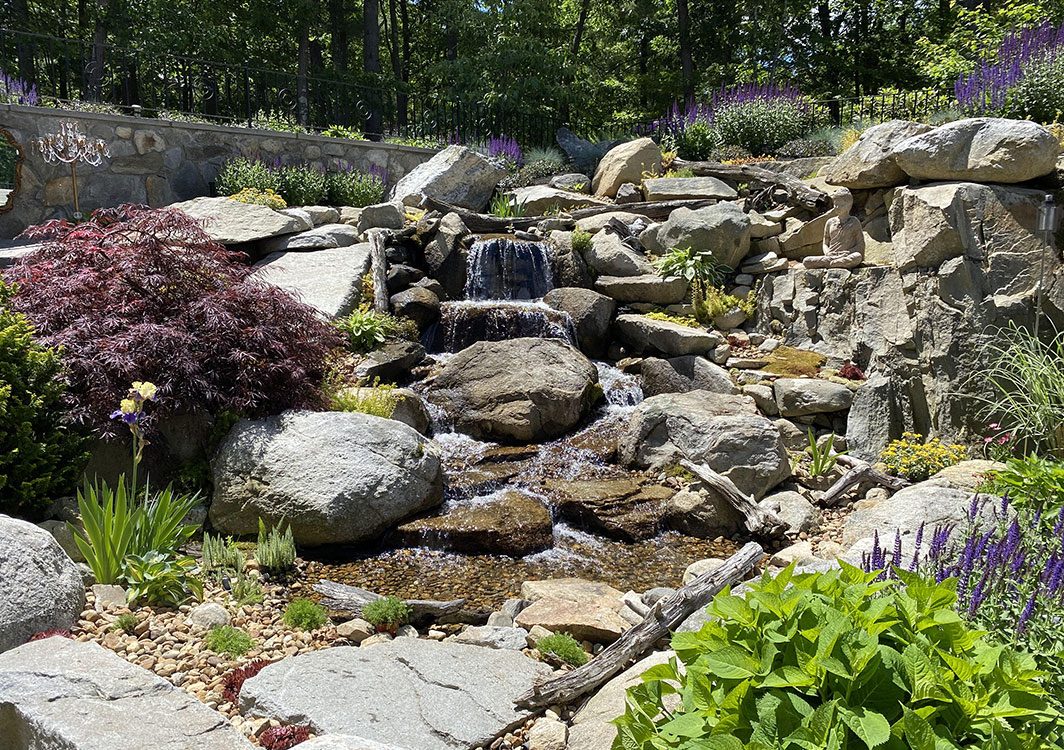
You can spot a fake waterfall from across the yard. A mound of rounded rocks, a trickle down the middle, and a black edge of liner peeking out at the bottom. A natural pond waterfall is a different animal, and the difference comes down to decisions made long before the water is turned on.
Why Most Backyard Waterfalls Look Fake
Two mistakes account for most of the artificial-looking waterfalls you see.
The bowling ball problem
The first is stone selection. Many waterfalls are built from a single pile of similar, rounded rocks. Stack enough of them and you get something that looks like a pile of identical bowling balls with water running over it. Nature does not sort its rocks by size and shape.
The rock volcano
The second is form. On a flat lot, the instinct is to build height by stacking a narrow, steep cone of rock and putting the waterfall at the top. That rock volcano instantly reads as artificial, because water in nature does not erupt out of a hill sitting alone in the middle of a lawn. It cuts down through ground that already has slope.
The fix for both: build the waterfall as if water carved it.
Choose Character Boulders and Mix Your Sizes
Character boulders are stones with real personality: weathered faces, flat tops, fractures, lichen, and irregular shapes. In New England, that usually means fieldstone with the look of the stone walls and ledge you already see in the woods.
On a recent job in Newton, MA, our crew worked with about 10 tons of fieldstone boulders, which is a typical amount for a backyard pond. Shawn Cutroni walked through how to pick and place that stone so the finished waterfall looks like it has been there for centuries. A few principles carry over to any project:
- Mix sizes on purpose. A handful of large anchor boulders, a good number of medium stones, and smaller fill stone and gravel. The large pieces do the visual work. The small pieces fill the gaps.
- Let big stones do big jobs. A few large boulders look more natural than many small ones, and they take up space efficiently, so you are not filling the pond with rock that crowds out water.
- Match the stone type. Stick with one kind of rock, so the feature reads as one geologic formation.
- Show the best face. Every boulder has a side that looks best. Turn it toward where people sit.
- Bury the base. A boulder that sits on top of the ground looks dropped. Setting it partway into the soil makes it look like it was exposed by erosion.
Build Tiered Shelves That Taper Into the Landscape
If your yard is flat, the answer is not a taller pile. It is a wider one.
Instead of a steep cone, build a series of wide, tiered shelves, with each drop stepping down to a pool or ledge below. Then extend the structural boulders out horizontally on both sides so the rockwork tapers gradually into the surrounding grade. The goal is for the waterfall to feel like part of a larger slope that happens to have water running through it.
Pack the borders with plants and the eye stops seeing a built object and starts seeing a landform.
This principle scales in both directions. Shawn recently joined a team of nine master builders on a Missouri project that used more than 400 tons of boulders and over 16 feet of vertical drop. The same rule applied there as it does to a 2-foot stream in a Massachusetts backyard: wide tiers, structural boulders that blend out, and no rock volcanoes.
Use Framing Boulders to Shape the Sound
A natural waterfall should sound like a mountain stream, a deep and echoing rumble, not a flat, splashy hiss. Much of that comes down to framing boulders.
- The pillars. Set two large, vertical framing boulders on the left and right of the main drop.
- The funnel. Those boulders channel the water tightly over the spillway and focus its energy downward instead of letting it spread thin.
- The echo. With sound trapped between two big stones, the waterfall projects out into the yard with a richer, deeper tone that does a good job of masking traffic and neighborhood noise.
Visually, they give the falls a defined opening, just like real water cutting through a ledge.
Pick the Spillway Stone Carefully
Every waterfall has one stone that matters more than the rest: the spillway, the rock the water actually pours over. On a large pondless waterfall build, our crew strapped and tested boulder after boulder to decide which became spillway stones and which became framing pieces.
A good spillway stone has:
- A relatively flat, clean lip so water leaves it in a sheet instead of dribbling down the face
- Enough overhang that the water falls free and does not cling to the rock
- Width that suits the flow, since a wide lip with too little water looks thin, and a narrow lip with too much looks forced
Special stones, like a pouring bowl at the top of a cascade or a flat destination stone at the edge of the pond where the family can sit and hand-feed koi, deserve the same care. They become the places people gravitate to.
Shape the Ledges Before the Plumbing Is Final
Good waterfall builders think about where the water will go before any water flows. We call it fluid dynamic pre-planning: shaping stone ledges to split, spread, and steer the flow while the plumbing can still be adjusted.
A slight tilt on a ledge sends water left or right. A notch concentrates flow into one strong sheet. A rough stone breaks water into froth. Getting this right during setting is what makes the finished falls look effortless.
Set Every Rock So It Never Moves
New England freeze, thaw cycles heave the ground every winter, and loose rock eventually moves. A waterfall that shifts is a repair job.
The three-point contact rule
A rock resting on one or two points will eventually rock, pivot, or slide under water pressure and winter ground movement. Every structural boulder should rest firmly on exactly three independent points of contact with the stones or stable ground beneath it. It should be stable on its own, with no props and no luck involved, before the next stone goes on.
Pro tip: Before our crew unhooks a boulder from the excavator straps, someone jumps on it and tries to rock it. If it moves even a fraction of an inch, it comes back out and gets reset.
Gravity-lock the structure
Beyond individual stones, the big structural boulders should interlock, each one leaning into and supported by its neighbors so gravity holds the whole assembly tighter. That interlocking is what lets a waterfall ride out decades of freeze-thaw without shifting.
Hide the Liner and Foam in the Rockwork
Nothing breaks the illusion faster than visible black rubber. A natural waterfall hides all of its infrastructure.
- Overlap the liner with the flow. Where liner pieces overlap, the upstream piece goes on top so water runs over the joint, not into it.
- Weave liner and foam into the stone. Rubber liner and waterfall foam are tucked behind and between boulders as they are set, so water stays on the liner and does not escape underneath the rocks.
- Bring the edges up and cover them. Liner edges should be raised above the water line and buried with soil, stone, and plants.
Hidden infrastructure is also leak prevention. If your waterfall is losing water, our guide to understanding waterfall leaks explains how to track it down.
Finish the Edges With Plants
Stone gives a waterfall its bones, but plants make it believable. Grasses, ferns, and groundcovers hide transitions and make the rockwork look settled. Plants in and around the water also help the whole ecosystem, as we explain in why plants are essential to a healthy pond.
For more ideas on adding a cascade to an existing pond, see Waterfall Wonders: Adding a Cascade to Your Pond. If you want the sound and look of falling water without an open pond, a pondless waterfall uses all of the same rockwork principles.
Watch: more from the crew on this topic.
Frequently Asked Questions
How much rock does a backyard pond waterfall need?
A typical backyard pond uses about 10 tons of stone, including boulders, smaller rock, and gravel. The exact amount depends on the size of the pond, the height of the waterfall, and how far the rockwork extends into the landscape. Larger waterfalls and long streams can take far more.
What is the best rock for a natural-looking waterfall?
Weathered fieldstone with irregular shapes, flat faces, and natural character looks most at home in New England. Use one type of stone throughout so the feature reads as a single formation, and mix large anchor boulders with medium and small stone instead of using rocks that are all the same size and shape.
How do I make my waterfall louder?
Set two large vertical framing boulders on either side of the main drop. They funnel water tightly over the spillway stone and trap the sound between them, which produces a deeper rumble instead of a thin splash. Increasing the drop height and choosing a spillway with a clean, overhanging lip also help.
Why do waterfall rocks shift over the winter?
Freeze-thaw cycles push and heave the ground every winter, and any rock that is not fully stable will eventually move. Every structural boulder should rest on three solid points of contact, and large stones should interlock so gravity holds them in place. A rock that wobbles during setting will move later.
Talk to New England Aquatic Landscaping
A natural-looking waterfall is a matter of craftsmanship, not luck. If you want a waterfall that looks like it was always part of your property, or you want to fix one that looks like a pile of rocks, contact us or call (774) 437-1160. We build and rebuild waterfalls across Massachusetts, Rhode Island, Connecticut, and New Hampshire.